











Executive summary
Lagging inventory data drives lost sales, order errors, and overstocking. Real-time management closes this gap by tracking stock movements the moment they happen across every location.
The business case spans stockout reduction, omnichannel fulfillment reliability, demand forecasting accuracy, and carrying cost reduction.
The case for real-time inventory management
Real-time inventory management gives businesses a continuously updated view of stock across every location. Where traditional inventory management relies on scheduled counts and manual entry, a real-time system captures every stock movement the moment it happens and reflects that change across every connected platform. This guide covers what real-time inventory management is, the technologies that enable it, and how to implement live inventory visibility effectively.
What is real-time inventory tracking?
Real-time inventory management is the continuous, automated tracking of inventory movements across warehouses, stores, and distribution channels. Rather than waiting for a scheduled inventory count or manual update, a real-time inventory system updates records at every transaction: each sale, return, transfer, and delivery adjusts stock levels automatically, without manual intervention required.
The core principle is a single, live inventory record. Every part of the business, from the warehouse management system to the e-commerce storefront, draws on the same real-time inventory data rather than working from separate, periodically synchronized snapshots.
Real-time inventory management vs. traditional inventory management
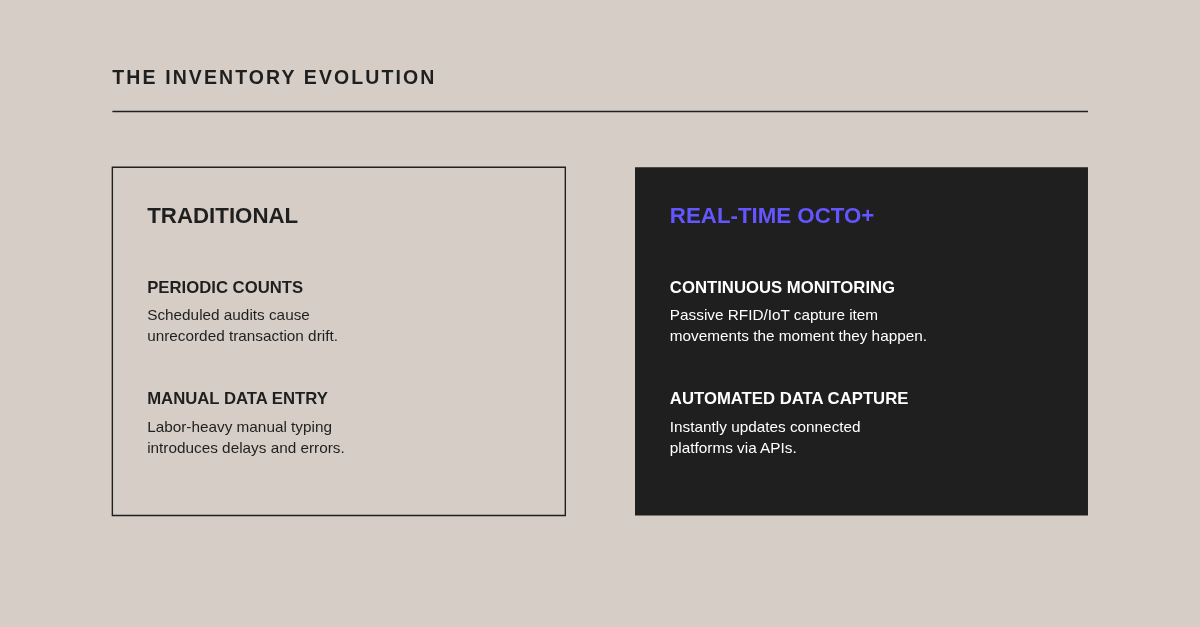
Periodic counting vs. continuous monitoring
Traditional inventory management relies on scheduled stock counts, whether weekly, monthly, or annual, to reconcile physical stock with system records. Between counts, inventory data drifts as unrecorded transactions accumulate. Real-time inventory management eliminates that drift by capturing every movement as it occurs, maintaining accurate stock continuously rather than periodically.
Manual entry vs. automated data capture
Manual inventory management relies on staff to enter stock movements, introducing delays and errors into the inventory record. Automated data capture through scanning, RFID, or connected POS systems records each movement immediately, keeping inventory levels precise without the labor cost and error rate of manual entry.
How real-time inventory tracking works
When a product moves, a data capture event occurs: an RFID read at a zone transition, a scan at receiving, or a transaction at the point of sale. The inventory management software processes that event and transmits the update to all connected systems through API integrations. Stock levels update in real time, order management reflects the change, and the business's view of available inventory across all locations adjusts within seconds.
Key technologies behind real-time inventory management
RFID for inventory tracking
True real-time inventory management, in the sense of continuous, automated stock visibility without human intervention, relies on always-on RFID infrastructure. Fixed readers at zone transition points and overhead readers mounted across retail floor zones capture item movements the moment they occur. When a product moves from the stockroom to the sales floor or through an exit point, the inventory management system updates immediately, with no associate involvement required.
Handheld RFID readers improve counting speed and accuracy significantly, but they still require a team member to actively conduct the count. That distinction matters: continuous, automatic inventory visibility at scale requires the always-on infrastructure, not periodic handheld passes.
Cloud-based inventory management software
Cloud-based inventory management software is the synchronization layer that makes real-time inventory management work across locations and channels. Stock updated in one warehouse becomes immediately visible to every connected system: the e-commerce platform, the order management system, and every other warehouse and store location. Cloud inventory management software provides the accessibility, scalability, and real-time data flow that enterprise inventory management requires.
Warehouse management system integration
A warehouse management system (WMS) is the operational core of real-time inventory management within a warehouse or distribution centre. WMS platforms manage inventory locations, track stock movements, direct picking and receiving workflows, and integrate with ERP, POS, and inventory management software to maintain accurate stock across the network. Without WMS integration, real-time inventory data stays within a single system rather than flowing across the business.
Why real-time inventory management matters: 7 critical benefits
1. Eliminate stockouts and lost sales
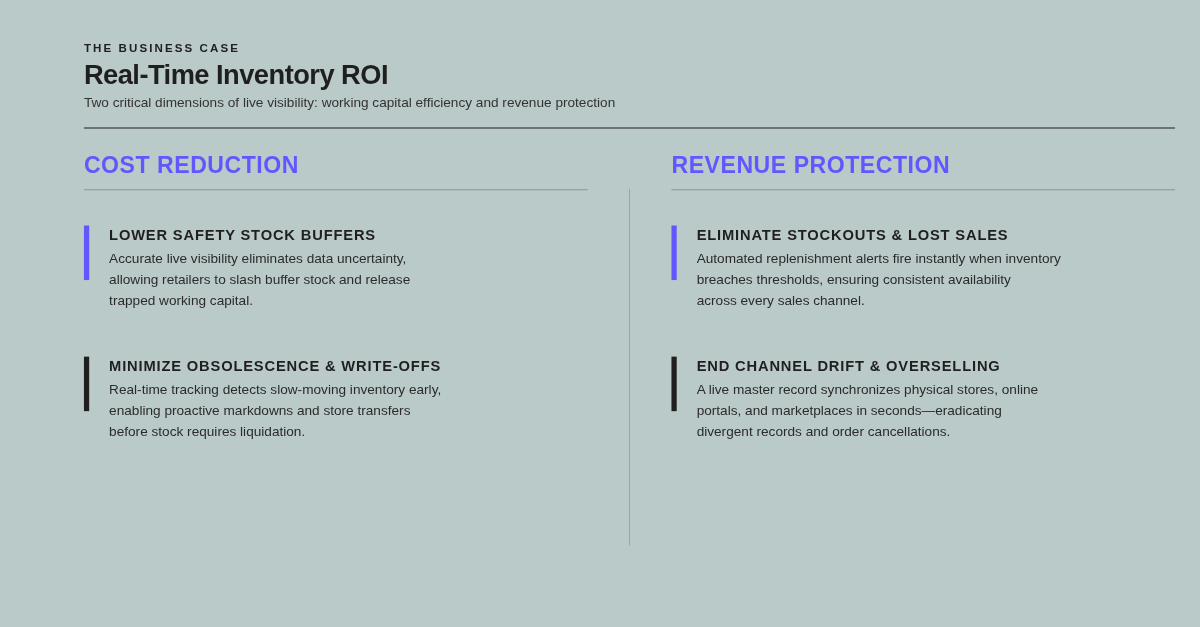
Real-time inventory management prevents stockouts by giving order fulfillment and replenishment systems current, accurate stock to act on. When inventory falls below reorder thresholds, the system triggers automated replenishment without waiting for a manual count to surface the shortfall. The result is better product availability, fewer lost sales, and customers who reliably find what they are looking for across all sales channels.
2. Reduce inventory carrying costs
Lower safety stock requirements
Traditional inventory management maintains large safety stock buffers to compensate for data uncertainty. When stock is unknown or unreliable, businesses hold more inventory than they need. Real-time inventory management eliminates that uncertainty: when the system knows exactly what inventory is available across every location, safety stock requirements reduce significantly, freeing up working capital for growth.
Minimize obsolescence and waste
Real-time inventory data gives buying teams visibility into slow-moving stock before it becomes a write-off. Inventory management systems with real-time data can identify aging stock and support proactive decisions about markdowns, transfers, or returns to suppliers. That reduces the financial impact of obsolete inventory and improves overall working capital efficiency.
3. Achieve 98%+ inventory accuracy
Continuous real-time tracking eliminates the gaps and data entry errors that cause inventory records to drift in traditional management environments. According to Gartner*, item-level RFID enables inventory improvements of more than 25%, reaching levels above 98%. Real-time inventory management maintains that precision on a continuous basis rather than only at the point of a scheduled count.
4. Enable omnichannel fulfillment
Ship-from-store capabilities
Real-time inventory management gives online order management systems visibility into stock held in physical stores. When a warehouse is out of stock, the order fulfillment platform can automatically route the order to the nearest store with available inventory. Ship-from-store only works reliably when store inventory levels are accurate and current, which real-time inventory management provides.
Real-time availability across channels
Synchronized inventory across sales channels ensures that the availability displayed online, in apps, and on marketplaces reflects actual physical stock. Customers avoid placing orders that cannot be fulfilled, cancellation rates fall, and the customer experience improves across all channels simultaneously.
5. Accelerate order fulfillment
The primary challenge in warehouse order fulfillment is not locating where products sit physically, since warehouses are generally well organised for that. The real challenge is knowing whether the stock the system records as available actually exists. Real-time inventory management addresses this directly: associates pick orders against an accurate, live inventory record rather than a count that may have drifted since it was last taken. That stock accuracy reduces pick errors, prevents failed fulfillment promises, and supports higher order volumes without proportional increases in labour.
6. Improve demand forecasting and planning
Inventory management decisions are only as reliable as the inventory data behind them. Real-time inventory management provides forecasting and planning teams with a continuous stream of accurate stock data, including how quickly different products move, which inventory levels trigger reorders, and how stock changes across locations and periods. That data quality improves demand forecasting, purchasing decisions, and inventory planning across the business.
7. Enhance customer satisfaction and loyalty
Customers trust businesses that deliver on their availability promises. Real-time inventory management is the operational foundation for that trust: accurate stock means fewer order cancellations, fewer out-of-stock situations, and more consistent fulfillment across all sales channels. Every order management interaction where accurate inventory enables a fulfilled order builds the customer trust that drives repeat purchases.
Real-time inventory management for e-commerce
Multi-channel inventory challenges
E-commerce businesses selling across multiple channels face a specific challenge: each channel maintains its own view of available stock unless a centralized inventory management system synchronizes them in real time. Without real-time inventory management, stock shown on the website, on marketplaces, and in stores quickly diverge, producing overselling on some channels and missed sales on others.
Synchronizing stock across channels
Real-time inventory management systems maintain a single master inventory record that every sales channel reads from simultaneously. When an item sells on one channel, stock levels update across all other channels within seconds, eliminating the window in which overselling can occur.
Preventing overselling and backorders
Overselling damages customer trust and creates operational complexity. Real-time inventory management prevents overselling by updating stock at the moment of purchase rather than in batches. When inventory reaches zero on any channel, the system marks the product as unavailable automatically, preventing orders that cannot be fulfilled.
Implementation challenges and how to overcome them
Product tagging and supplier involvement
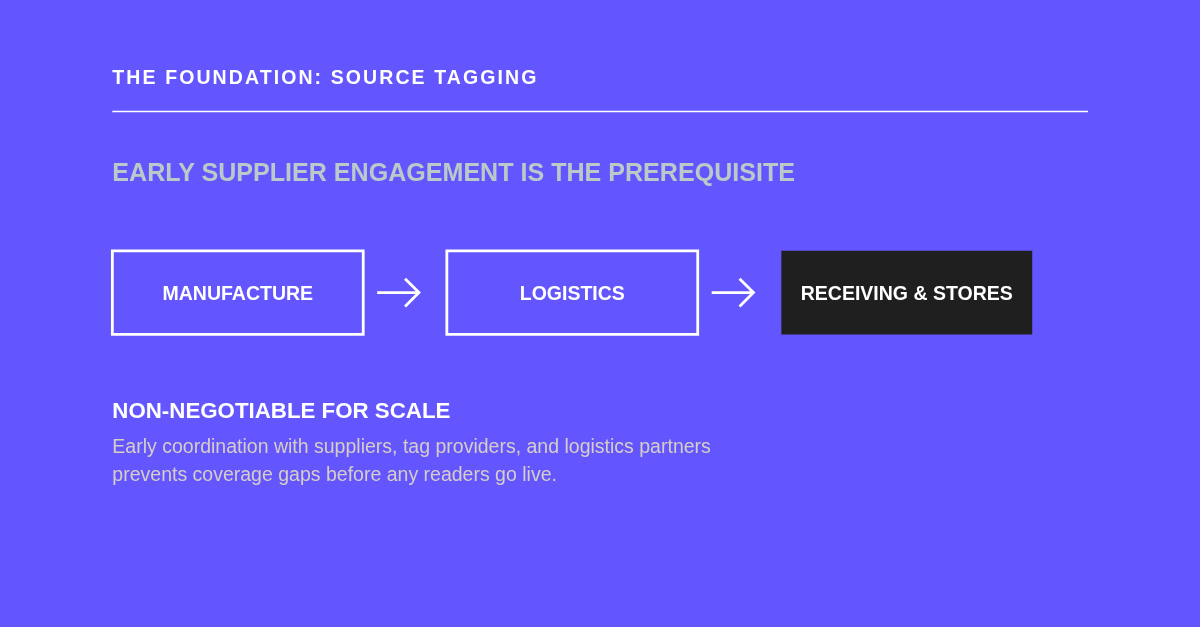
Real-time inventory management at item level only works when every product carries an RFID tag. That dependency reaches upstream into the supply chain: source tagging, where products are tagged at the point of manufacture, is the most scalable approach and the one that delivers the cleanest inventory data from the moment goods arrive. Achieving it requires early engagement with suppliers and, in many cases, coordination with tag providers and logistics partners. Retailers who treat tagging as a technical afterthought rather than a program requirement consistently encounter gaps in coverage that undermine system accuracy. Bringing supply chain partners into the conversation early is not optional: it is part of the implementation.
Upfront capital investment
Real-time inventory management requires investment in hardware, software, and integration. Cost components include data capture devices, inventory management software licensing, integration with existing ERP, WMS, and e-commerce platforms, and change management. The durable investment is in inventory management software and integration, where the long-term value of real-time visibility is built.
System integration complexity
Connecting real-time inventory management with existing ERP, WMS, and e-commerce platforms is the most technically complex part of most implementations. Native API connectors reduce integration risk and time-to-value. Before integration begins, conduct an inventory data accuracy audit: real-time inventory management amplifies the quality of the data it works from, so starting with clean, verified stock records is essential.
Staff training and change management
Real-time inventory management introduces new workflows for warehouse teams, store associates, and inventory managers. Training teams on new scanning processes, inventory management software interfaces, and fulfillment workflows is essential. Organizations that invest in change management alongside technology deployment achieve better adoption and faster time-to-value.
How to implement real-time inventory management: step-by-step
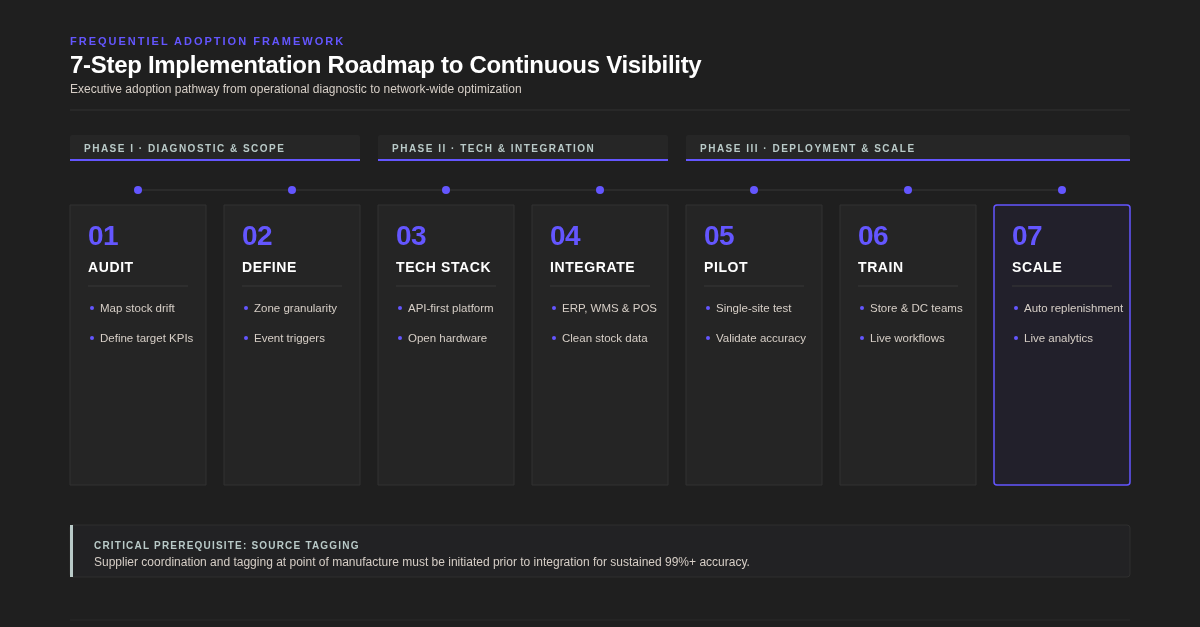
Step 1: Audit current inventory management processes. Assess current workflows, identify where stock records become inaccurate, and document the operational and financial impact of those gaps. Define measurable KPIs for the real-time inventory management implementation before selecting any technology.
Step 2: Define tracking requirements. Decide whether the primary need is location tracking (where each item is within the store) or event-based updates (what stock is currently available across all channels). Real-time inventory management for omnichannel retail typically requires both.
Step 3: Choose the right technology stack. Select hardware and inventory management software based on operational requirements. Prioritize API-first inventory management software with native connections to existing ERP, WMS, and e-commerce platforms. Avoid hardware lock-in by choosing software that supports multiple data capture technologies.
Step 4: Integrate with existing systems. Connect real-time inventory management with ERP, POS, WMS, and e-commerce platforms. Validate that stock levels synchronize correctly across all integrated systems before going live.
Step 5: Pilot in one location. Validate real-time inventory management performance in a single store, warehouse zone, or product category. Measure inventory accuracy, order fulfillment times, and stock synchronization against KPIs defined in Step 1 before scaling.
Step 6: Train your team. Train warehouse and store teams on new workflows and technology. Ensure everyone who interacts with inventory understands how real-time inventory management changes their process and what the new workflows require.
Step 7: Monitor KPIs and optimize. Track stock accuracy, order fulfillment times, inventory levels by location, and carrying costs continuously after go-live. Use inventory management analytics and reporting to identify improvements and refine processes over time.
Real-time inventory management best practices
Maintain data hygiene. Real-time inventory management is only as reliable as the data it works from. Establish governance for inventory data quality and conduct regular audits to catch and correct drift in stock records.
Set automated reorder alerts. Configure the inventory management system to trigger automated replenishment when stock falls below defined thresholds. Automated reorder management removes manual monitoring from the workflow and ensures stock never reaches zero before action is taken.
Conduct regular system audits. Even with real-time inventory management in place, periodic physical verification of stock provides an independent check and identifies any systematic gaps in data capture.
Leverage analytics for continuous improvement. Real-time inventory management generates a continuous stream of inventory data. Use inventory management analytics to understand how stock moves across locations, which products drive the most management complexity, and where process improvements would have the greatest impact on order fulfillment and customer satisfaction.
Software-led real-time inventory management platforms such as Octo+ by Frequentiel connect inventory data across stores, warehouses, and supply chain operations, providing the live stock visibility that omnichannel retail and e-commerce fulfillment depend on.
Sources
* Gartner, "How Retailers Can Leverage Item-Level RFID to Boost Revenue and Reduce Cost", G00788040, 2023. gartner.com/en/documents/4227199
