











Executive summary
Omnichannel inventory management connects stock data across stores, warehouses, and online sales channels, giving retailers a unified view of what is available and where. But making inventory accessible across channels is only part of the challenge. The real priority is ensuring that inventory data is accurate enough to support reliable fulfilment.
Key takeaways
- One inventory, multiple channels: unlike multichannel retail, omnichannel inventory management treats stock as a shared resource, allowing retailers to fulfil orders from the most suitable location
- Inventory accuracy is essential: inaccurate stock records lead to cancelled orders, stockouts, and inefficient replenishment. Reliable inventory data is the foundation of successful omnichannel operations
- RFID improves inventory visibility: faster, more frequent stock counts and item-level tracking help retailers maintain accurate records across their entire network
- Better stock control improves performance: effective omnichannel inventory management reduces fulfilment errors, limits excess stock, supports demand forecasting, and improves customer satisfaction
- Integration makes it work: a successful omnichannel inventory management system connects existing retail technologies, synchronizes inventory updates in real time, and supports store teams in their daily operations
The omnichannel inventory challenge
Retailers selling across multiple channels have always faced the same operational challenge: merchandise sits where customers are not looking, and it's unavailable where they actually need it. Omnichannel inventory management solves this issue by connecting records from every outlet, distribution centre, and digital sales channel into a unified picture that allows retailers to fulfil orders.
This guide covers what omnichannel inventory management is, the benefits it delivers for fashion, footwear, and sporting goods retailers, the demands of implementing it, and how RFID transforms the precision that makes the whole system function.
Omnichannel vs multichannel: what actually changes
Most retailers already sell in stores, online and on marketplaces. What makes it omnichannel is that every one of those channels draws on the same inventory record.
In a multichannel model, each channel manages its own inventory independently. A retailer might sell through their website, physical outlets, and third-party services, but the availability records for each exist in a separate system. This structure creates predictable issues: warehouses run out of goods while outlets carry excess of the exact same items with no mechanism to connect availability with demand across the network.
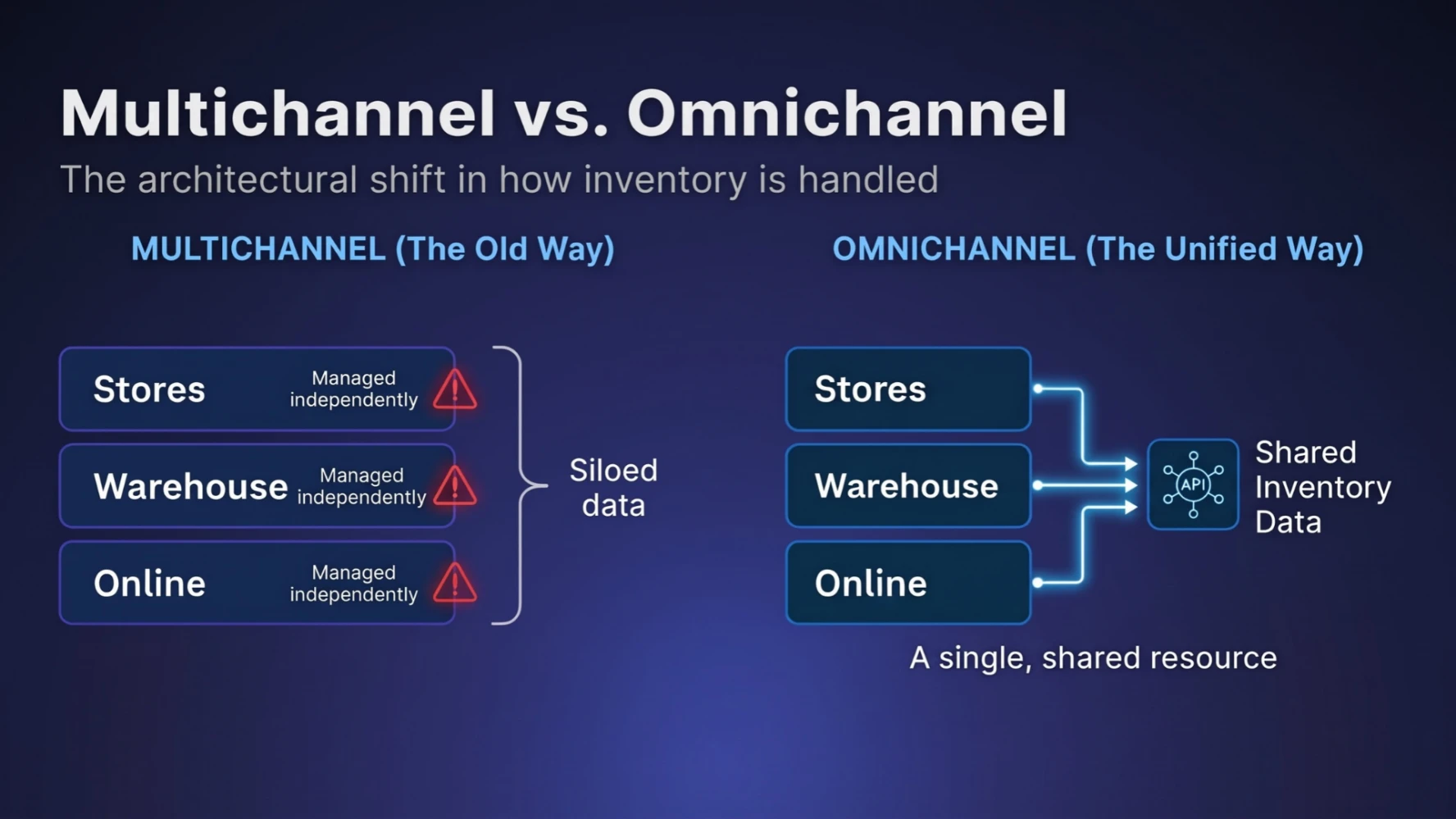
Omnichannel inventory management creates a centralized architecture that aggregates inventory data from every node in the network. When a warehouse cannot fulfil an order, the system automatically routes it to the nearest outlet with units on hand, protecting revenue across all channels simultaneously.
The shift is operational: treating available inventory as a shared resource that serves customer needs wherever it appears, rather than managing each route as a separate inventory pool with no visibility into what others hold.
Why stock accuracy is the real dividing line
Omnichannel inventory management only works if the stock level in the system matches what is physically in each store and warehouse. Every BOPIS promise, every ship-from-store order and every routing decision depends on that number being right.
Retail analyst firm IHL Group estimates that store inventory record inaccuracy impacts up to 65% of SKUs in non-automated retail environments, directly driving the out-of-stocks and phantom inventory behind fulfillment cancellations.¹ Barcode-based counts are labour-intensive and disruptive, so most retailers run a full count once a year, and records drift further from reality in between.
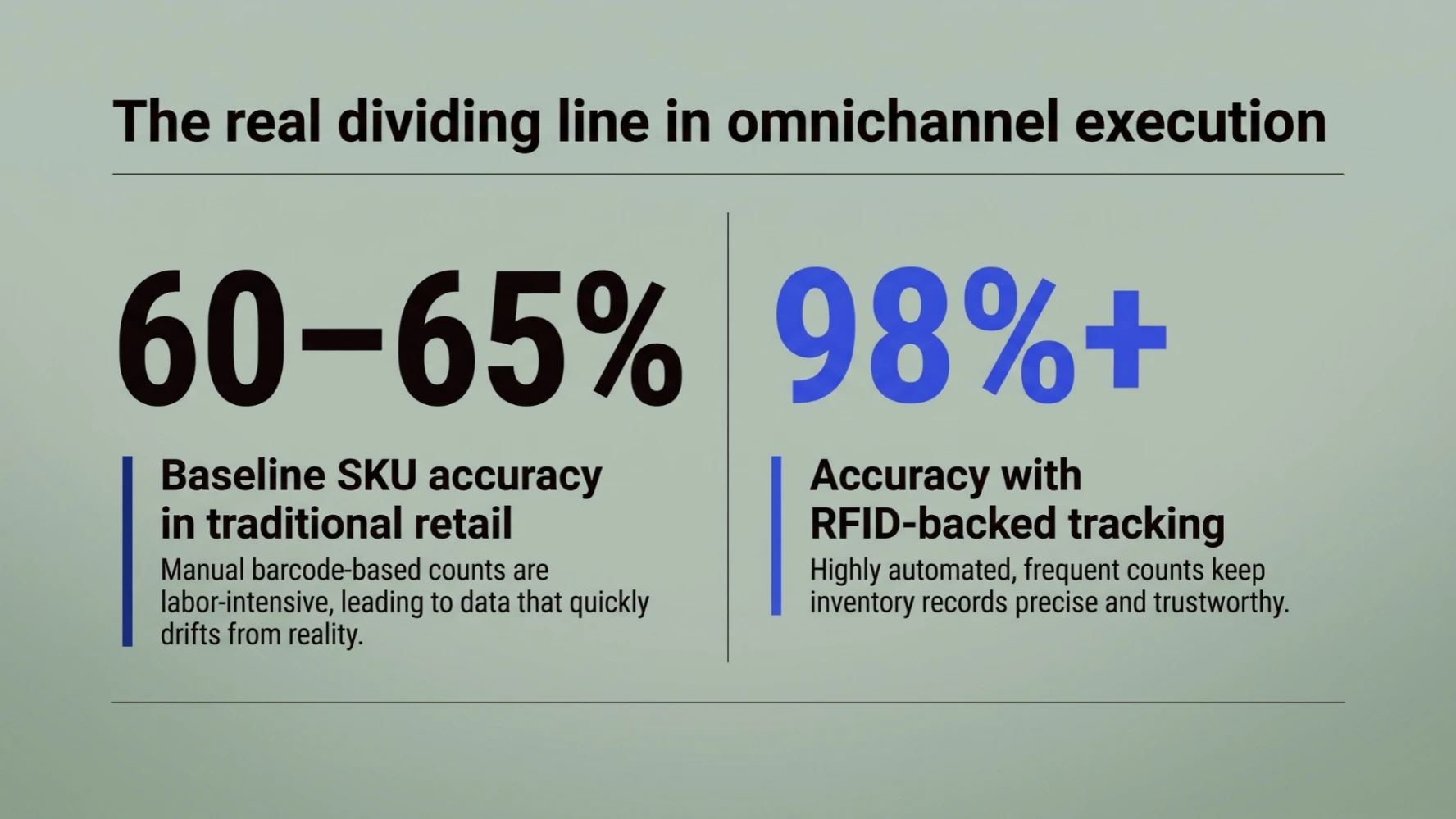
RFID solves this by making counts fast enough to run often. Tags are read automatically, so a full store count takes a fraction of the time a barcode count does, and stock levels can be corrected weekly rather than once a year. The result is a stock figure for every SKU at every location that the system can trust.
For omnichannel inventory management to work reliably at scale, that level of precision is the foundation that every fulfilment decision and planning function depends on.
Key benefits of omnichannel inventory management
Inventory visibility across every sales channel
With precise inventory data flowing from outlets, warehouses, and distribution centres, the system provides an enterprise-wide picture of availability across all sales channels simultaneously. Retailers gain visibility that helps them manage customer expectations reliably, offering merchandise that can actually be fulfilled rather than relying on batch-updated data that may not reflect what is physically on hand at any given site.
Fewer failed promises on BOPIS and ship-from-store
Buy Online, Pick Up In-Store and ship-from-store programmes frequently fail when supported by legacy applications that cannot keep stock levels accurate. Without reliable stock data, these fulfilment processes face cancellation rates that can reach 20-30% because the inventory the system promises is not physically there. According to Gartner, retailers deploying item-level RFID raise store stock accuracy above 98%, shrinking safety-stock buffers, making omnichannel fulfillment reliable, and driving a 1% to 3.5% improvement in sell-through across store and digital channels.²
Reduced carrying costs and better inventory control
Inaccurate inventory records cause replenishment to trigger too early, creating safety stock buffers that grow unnecessarily large and cause overstocking that ties up capital. A reliable setup eliminates the need for those buffers. When the system knows precisely what stock is on hand across every outlet, retailers can control inventory levels more effectively, reduce carrying costs, and redirect resources toward growth.
Improved forecasting through trustworthy inventory records
Reliable inventory records are the foundation for network planning across multiple channels. When AI and predictive analytics methods receive accurate, up-to-date stock data they can trust, they generate forecasts that help retailers manage inventory so that purchasing decisions align with actual demand, reducing both stockouts and overstocking simultaneously.
Better customer experience and satisfaction
When inventory records are precise and fulfilment execution works as promised, customers experience fewer order cancellations, shorter delivery windows, and seamless service across all sales channels. Customer satisfaction improves when the brand consistently delivers on omnichannel promises, and that reliability builds loyalty that inconsistent omnichannel execution cannot.
Core challenges of omnichannel inventory management
Disconnected systems and no single source of truth
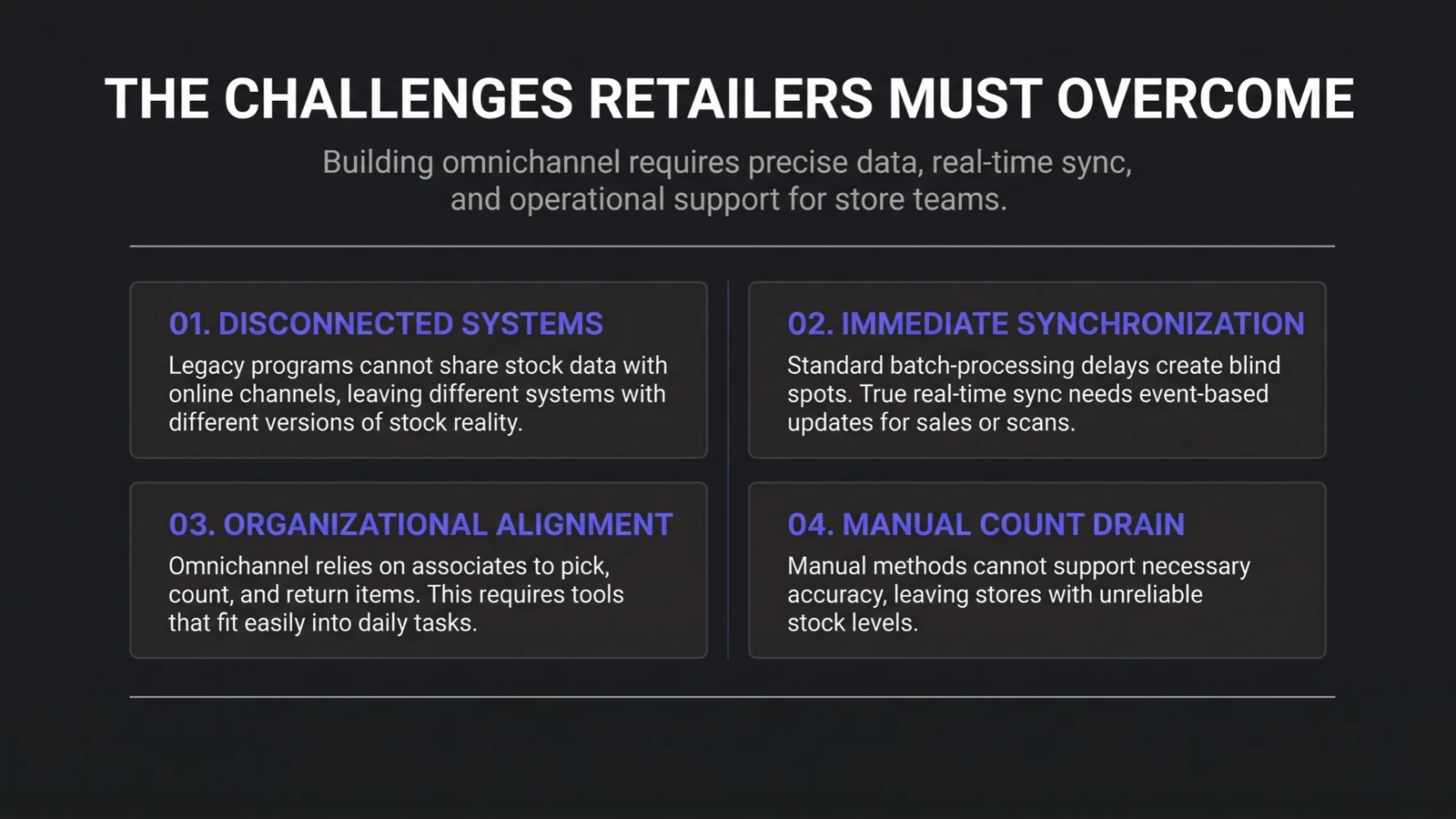
Legacy POS and ERP systems were built for stores that sold through one channel. Most cannot share stock data with e-commerce platforms in real time, and connecting them means dealing with incompatible data structures, limited APIs and significant integration costs. The result is that every system holds a different version of stock reality: a customer orders a product shown as in stock online, and the order is cancelled because the last unit was sold in store hours earlier. Solving this calls for a centralized architecture that aggregates stock data from every fulfilment node and updates immediately.
Immediate synchronization at scale
Standard systems rely on batch processing, updating stock levels once an hour or at end of day. In high-velocity retail activity, that latency creates blind spots that make omnichannel order fulfilment unreliable. True real-time synchronization depends on event-based architecture where every transaction, at any point in the network, immediately updates the global omnichannel inventory picture without delay.
Organizational alignment across teams
Omnichannel shifts daily tasks onto store associates: picking online orders, running RFID counts, managing returns from other channels. That only works if the tools fit into their day and accountability is clear. Aligning store teams, e-commerce, IT and logistics around a shared approach needs sustained commitment and platforms that support frontline workflows rather than adding to them.
Manual inventory tracking and the productivity drain
Commercial environments relying on manual processes cannot achieve the precision that omnichannel order management requires. The time and labour involved in conducting accurate manual counts makes high-frequency visibility unachievable, leaving stock levels unreliable and exposing omnichannel fulfilment execution to errors that damage customer experience.
What RFID adds to an omnichannel inventory stack
RFID transforms omnichannel inventory management by providing the stock accuracy that makes every other part of the architecture reliable. The benefits extend well beyond faster cycle counting.
More frequent, more reliable inventory tracking
RFID reads many tags at once without line of sight, so a store count takes a fraction of the time a barcode count does. This allows retailers to track inventory weekly rather than once a year, keeping data precise enough to support order management reliably across all sales channels.
Inventory visibility at receiving docks
RFID at receiving docks records products as shipments arrive, immediately identifying any gap between what was shipped and what was received. This provides visibility across the fulfilment network, helping retailers manage supply chain performance and catch issues before they affect customer orders downstream.
Item-level location awareness
Rather than knowing a site has five units of a SKU, RFID tells the solution exactly where each unit is located: on the floor, in the stockroom, or in a fitting room. This allows associates to locate specific products for customers instantly and enables the system to route ship-from-store orders to outlets where staff can actually find and fulfil them seamlessly.
Returns management
RFID allows retailers to authenticate returned merchandise, process it back into the inventory record correctly, and make it available for resale without delay. This improves returns recovery rates, helps businesses control how returned inventory is handled, and ensures returned products re-enter the active inventory pool before they lose seasonal value.
Where AI and automation fit in
When omnichannel inventory management is supported by precise, real-time RFID tracking, AI and automation tools can operate as intended rather than generating recommendations based on unreliable inventory data.
Demand forecasting
AI-powered demand forecasting analyses purchasing data across sales channels and outlet locations, helping retailers optimise inventory placement and reduce the risk of costly over- or under-ordering.
Automated replenishment
Automated replenishment tools trigger restock alerts the moment products leave the floor.
Data quality as the key dependency
Accurate RFID stock data is what transforms AI from a theoretical benefit into a practical tool that helps retailers manage inventory more efficiently. AI applied to imprecise records generates unreliable guidance that creates more operational problems than it solves.
Essential components of an omnichannel inventory management system
An effective platform needs to support several operational requirements across channels and outlet locations:
- A centralized management system that aggregates inventory data from every sales route, outlet, and warehouse in real time, providing a unified view of omnichannel inventory across the entire business
- API-driven architecture that connects the solution with existing POS, ERP, WMS, and e-commerce systems without batch processing delays, ensuring inventory data flows seamlessly across all integrated platforms
- Every event (a sale, an RFID scan at a dock door, an online order) immediately updates the global inventory picture
- Feeds accurate stock levels to the order management system (OMS), so routing and fulfilment decisions are based on what is actually on hand
- WMS and 3PL integration that extends inventory visibility beyond owned assets to include third-party logistics providers, offering a complete view of resources across the entire network
The most important criterion for businesses evaluating omnichannel inventory management software is integration capability. A software-only, API-first platform that connects to existing systems without hardware lock-in gives retailers the flexibility to change hardware or add systems later without replacing the platform.
Best practices and KPIs
Build on an honest baseline
Before deploying any setup, audit current inventory precision across all outlets. Most retail environments without RFID operate at 60-65% accuracy.¹ Documenting this baseline is the only reliable way to prove ROI after the system goes live.
Update safety-stock policies based on real inventory records
Legacy safety stock policies assume inventory records are unreliable. When RFID raises precision to 98%², those assumptions become outdated. Retailers should update safety-stock parameters based on verified records, lowering buffer thresholds to free up capital and improve on-floor product availability where it can generate sales and improve customer loyalty.
Monitor performance continuously
Omnichannel inventory management success requires ongoing monitoring rather than a launch. Key metrics include inventory accuracy, BOPIS and ship-from-store cancellation rates, order fill rates, and out-of-stock rates. Regular review allows management to identify challenges, optimise the platform, and improve fulfilment execution before issues affect customer experience.
Common pitfalls
Underestimating inventory quality requirements
The most frequent implementation pitfall is assuming that existing inventory records are adequate. Omnichannel order routing breaks down immediately when the underlying records are imprecise. Businesses that attempt this without first solving their inventory precision problem discover the consequences quickly and at significant cost.
Neglecting change management on the sales floor
Platforms only deliver value when the people using them understand what is expected of them. Associates need comprehensive training and clear accountability for new omnichannel responsibilities. Deploying technology without addressing the human and process dimensions is the most common way omnichannel programmes underperform against their business cases.
Skipping the pilot phase
Skipping the pilot to meet aggressive timelines almost guarantees that minor integration challenges and unrefined workflows will compound into significant operational failures when the platform is live at full scale. The pilot is the way to surface and resolve problems before they become visible to customers and damage brand reputation.
Omnichannel inventory management is the operational foundation that allows retailers to fulfil customer orders across all sales channels with confidence. RFID-backed stock accuracy is what makes it reliable at scale, and a unified inventory management platform is what connects every part of the fulfilment network into a seamless operational whole.
To learn more about how Frequentiel's Octo+ helps retailers build omnichannel inventory management capability, contact the team to discuss your specific challenges.
Talk to the Frequentiel team about your omnichannel challenges
Sources
¹ Chuang, H. H.-C., & Oliva, R. (2016). Erratum to "Inventory record inaccuracy: Causes and labor effects". Journal of Operations Management, 42-43, 96-110. elsevier.com/locate/jom
² Unni, S. (2021/2023). Innovation Insight for Item-Level RFID in the Transformation of the Retail Store (Gartner Research Report No. G00788040). Gartner, Inc. gartner.com
