










Executive summary
What does it take for a retail operation to know, at any moment, exactly what stock it has and where?
Item-level RFID is the answer a growing number of retailers are building their operations around. When deployed well, it transforms inventory counting, stock movement between zones, online order fulfillment, and loss prevention into reliable, data-driven processes.
The business case is consistent across apparel, footwear, luxury, and department stores: better stock data produces higher on-shelf availability, faster cycle counts, more reliable omnichannel fulfillment, and item-level visibility that supports proactive loss prevention.
Reaching those outcomes takes careful implementation: the right software platform, a realistic approach to integration complexity, and the operational change that any new workflow requires.
Three retailers show what this looks like in practice. Varley moved from below 70% accuracy to 99%. RP55 cut full facility audits from five days to two. KIABI runs RFID across hundreds of stores, embedded in checkout, cycle counting, and loss prevention.
The case for item-level RFID
Retail operations generate more inventory information today than at any previous point in history. But is that inventory information reliable? With item-level RFID technology, it can be. RFID gives retail teams a way to know, in real time, what products are actually on the shelf.
RFID gives every product a unique, trackable identity and keeps inventory records coherent as they move between systems. For retailers running hundreds of locations and thousands of SKUs, that coherence is what turns raw RFID reads into an inventory management tool retailers can actually use.
This article covers what RFID technology is, where it creates measurable value in retail, and what a practical RFID deployment looks like from first pilot to full rollout.
What is RFID technology in retail?
RFID (Radio Frequency Identification) is a technology that uses radio waves to identify and track physical items. Each item carries a small RFID label, a chip attached to an antenna, that holds a unique identifier. A reader picks up that identifier wirelessly, from a distance, without needing to see the label directly. In retail, that identifier links to item-level information: what the product is, its size, colour, price, and its position in the supply chain.
So how does RFID technology compare with the tracking technologies retail teams already use, such as barcodes?
RFID vs. barcodes vs. NFC: key differences
| Barcode | RFID | NFC | |
|---|---|---|---|
| Line-of-sight needed | Yes | No | No |
| Capture speed | One at a time | 200-1,000+ tags/sec | One at a time |
| Information capacity | 20-100 characters (1D) | 96-512 bits standard | Up to 8KB |
| Durability | Susceptible to damage | Highly durable | Durable |
| Price per unit | $0.01-$0.10 | $0.03 - $0.05 in volume | ~$0.10-$0.45 |
| Best use | Low-volume, cost-sensitive | High-volume item-level tracking | Consumer-facing, short range |
A barcode still wins on raw price per label, and it remains the right choice for a low-volume retailer or a single fixed scan point at checkout. A barcode also requires a clear line of sight and processes one item at a time, which is where the comparison starts to matter once volume climbs. RFID pays back where bulk reading, item-level identification, and real-time information flow justify the per-tag price, letting a store capture hundreds of products in the time a barcode scanner reads one.
How RFID works in the retail environment
An RFID setup has three parts that work together: the tag sits on the product, the reader picks up the tag's signal, and the software turns that signal into inventory information the retailer can act on. Each part matters, but they carry different weight. RFID tags and readers have become widely available and increasingly interchangeable across suppliers. The software is what separates a setup that generates data from one that delivers operational recommendations, replenishment alerts, and business insights based on live, real-time information down to the individual item.
RFID components: tags, readers, and software
RFID tags
- A passive UHF label combining a chip and an antenna, attached to every individual item
- Stores a unique code identifying that specific product, down to size and colour
- No battery required: passive UHF tags draw power from the reader's signal when in range
RFID readers
- Devices that detect and capture tag information wirelessly
- Three main types used in retail:
- Handheld readers, used by store associates for cycle counts and item searches
- Fixed readers, installed permanently at dock doors, fitting rooms, exits, and zone transition points
- Overhead readers, ceiling-mounted, enabling automated continuous inventory counts across retail floor zones without staff involvement
- Fixed and overhead readers process 200 to 1,000 RFID tags per second in real retail environments
RFID software
- Receives raw tag reads from every reader across the network
- Delivers operational recommendations, replenishment alerts, and business insights based on live, real-time data down to the individual item level
- Connects RFID information to the systems the retailer already runs on, supporting rather than duplicating the existing technology stack
What to look for in RFID inventory management software
The features below reflect the core capabilities a retail RFID platform should cover. For full details, visit Octo+ by Frequentiel.
Inventory management and product location
- Cycle counting using RFID or barcode readers
- Real-time stock movement tracking between zones with fixed readers
- Replenishment monitoring to reduce out-of-stocks
- Sub-location customisation (sales floor vs stockroom) and item localization using virtual shielding
Omnichannel and logistics
- Inventory sync across ERP, OMS, POS, and e-commerce platforms
- Click & Collect, Ship-from-Store, BOPIS, and e-Reserve support
- Inbound and outbound flow validation with real-time logging
In-store efficiency and checkout
- Product search and availability check with handheld readers
- Shelf replenishment and backroom stock management
- Hybrid barcode and RFID workflows on the same interface
- Assisted checkout, mobile POS, and self-service checkout flows
Traceability and loss prevention
- Full item serialisation and lifecycle tracking
- Digital Product Passport compliance
- Shrinkage detection and suspicious movement alerts
- RFID tag authentication against counterfeits
Multi-site management
- Centralised visibility across stores, distribution centres, and fulfillment operations
- Compatible with all major RFID and barcode hardware
- Offline support when network coverage is limited
Key applications and use cases of RFID in retail
Retailers deploy RFID against specific, measurable problems rather than as a general technology upgrade. The use cases below cover the ones retailers ask about most, from stockroom accuracy to product authentication, and each shows what RFID actually changes on the ground.
Real-time inventory accuracy
Every item carries a unique Electronic Product Code (EPC), making it individually identifiable across the entire retail network. When a handheld reader scans tagged products, or when fixed or overhead readers capture movements automatically, the software compares what should be present against what is actually detected and flags any gap immediately.
RFID cycle counting replaces one-by-one barcode scanning with bulk reads: a single handheld pass through a zone captures every tagged item simultaneously rather than scanning each one in sequence. This brings inventory accuracy from a typical industry baseline of 60-65% to 95-99% in most deployments. Automated low-stock alerts trigger restocking without requiring a staff member to check the shelf manually.
Varley, for example, moved from below 70% inventory accuracy to 99% after deploying Octo+, with automated discrepancy flagging replacing the counting process that had been absorbing team time across every shift.
Streamlining retail operations: from stocking to checkout
RFID-enabled cycle counts run significantly faster than manual barcode counting, since a single handheld pass across a zone reads all tagged items at once. Associates complete counts that would have taken a full team hours in a fraction of the time, freeing staff for customer-facing work.
KIABI integrated Octo+ with self-checkout stations across 500 locations. At these stations, RFID reads a full basket of products simultaneously, identifying every item without individual scanning. Security tag deactivation follows as part of the checkout completion process, directly supporting KIABI's "Easy Shopping" customer experience.
Enhancing the customer experience: smart fitting rooms and beyond
Fixed readers inside fitting rooms identify products a customer brings in and display availability in other sizes or colours without requiring staff involvement. Store associates can locate any specific item across the floor or stockroom in seconds using a handheld reader, cutting the lag between a customer question and a confirmed answer.
According to a Gartner study*, a major fashion retailer deployed RFID-enabled smart mirrors in several locations across the US, allowing customers to request items without leaving the fitting room. The mirrors identify the product, size, and colour brought in and can offer personalised styling recommendations.
Loss prevention and security
Fixed readers at store exits detect unauthorised item movement with item-level precision. Rather than triggering a generic alarm, the system identifies the specific EPC that caused the alert: which product it is, where it has been on the floor, and whether it fits a broader pattern across time or location.
KIABI uses Octo+ to identify the specific product triggering a security alert, helping security teams analyse theft patterns rather than respond to generic alarms.
Omnichannel fulfillment and BOPIS
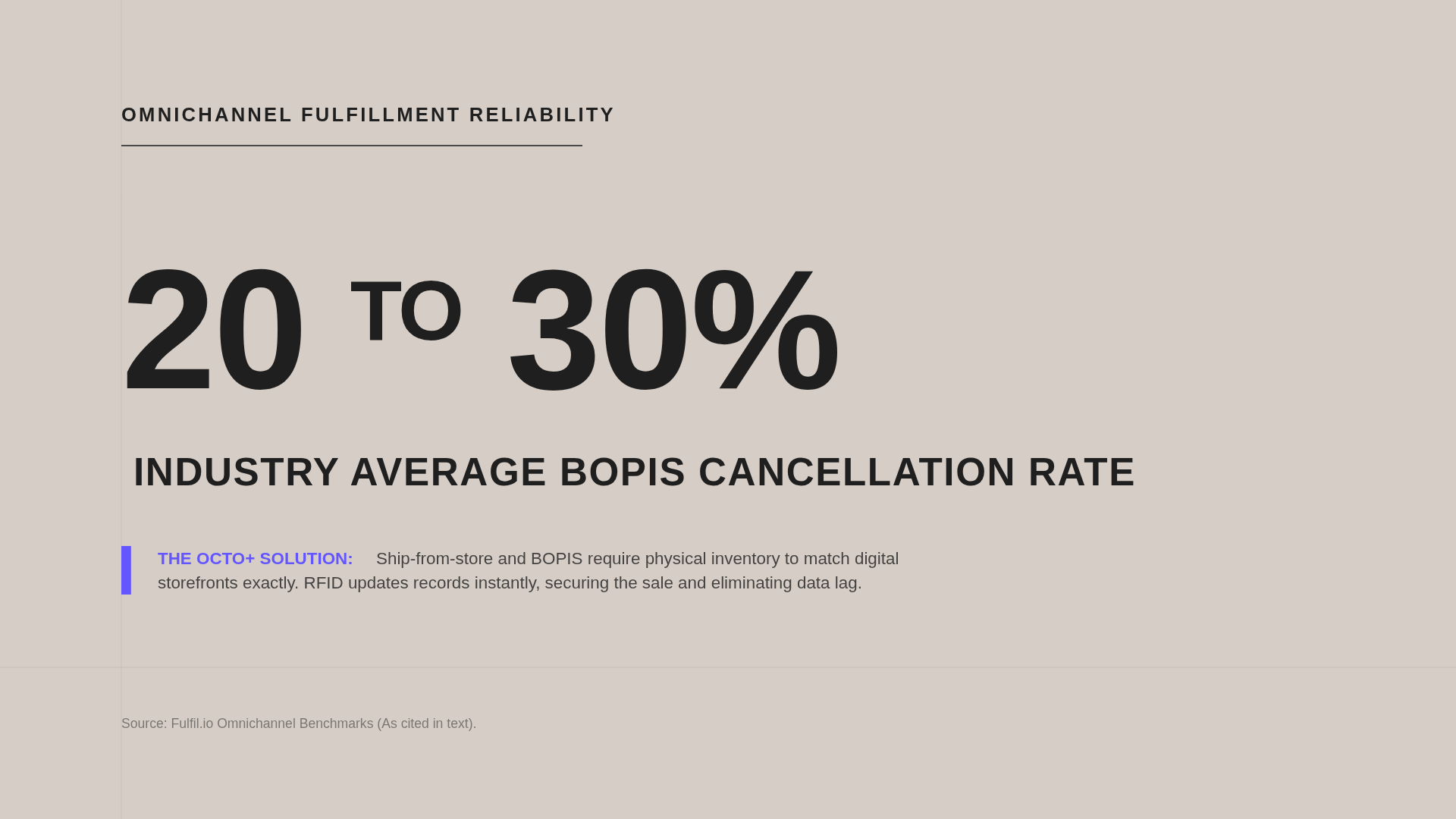
BOPIS and ship-from-store only work reliably when the inventory information behind them reflects what is physically available at the moment of purchase. RFID updates records the moment an item moves, so the availability shown to an online customer reflects the physical shelf rather than the last manual count. Without that accurate, real-time picture, industry BOPIS cancellation rates sit at 20-30%, according to Fulfil.io**.
Supply chain visibility and stock movement traceability
RFID enables traceability of stock movements between the stockroom and the sales floor, either through fixed readers at zone transition points or through manual reads with handheld devices. This makes it possible to know, in real time, where every tagged item is within the store environment: whether it is in the backroom, on the floor, or in a fitting room.
Source tagging means every item enters the system at the point of manufacture, giving the retailer visibility earlier in the supply chain. RP55 transformed inbound verification using Octo+, achieving 100% shipment accuracy for major retail partners including Dillard's, Saks, and Nordstrom.
Product authentication
RFID provides a verifiable digital record of every product's origin and movement through the supply chain. For luxury goods and premium apparel, this creates a reliable authentication mechanism at any point in the chain, from production to point of sale to post-purchase returns. It also provides the foundation for Digital Product Passport compliance under emerging EU regulation, connecting physical products to their full lifecycle data.
The benefits of implementing RFID in retail
The use cases above explain the mechanics. The benefits below explain what those mechanics deliver against the retail KPIs that finance and operations teams actually measure.
Accurate inventory and reduced out-of-stocks
According to Gartner*, retailers deploying item-level RFID achieve more than 25% improvement in inventory accuracy, reaching overall levels greater than 98%, alongside 1-3.5% increases in sell-through from lower stockouts and better inventory management. Automated low-stock alerts help prevent out-of-stocks before they happen, triggering restocking when items drop below threshold rather than waiting for the next count to catch a gap.
Varley moved from below 70% inventory accuracy to 99% after deploying Octo+, with restocking directly improving conversion and KPIs across their UK and US locations.
Improved labour efficiency
Gartner* documents 10-15% reductions in inventory-related labour hours as a result of item-level RFID deployments. That time shifts toward customers and better service. Store associates who were spending time on manual counts, shipment reconciliation, and stockroom searches redirect that capacity toward customer service and floor sales.
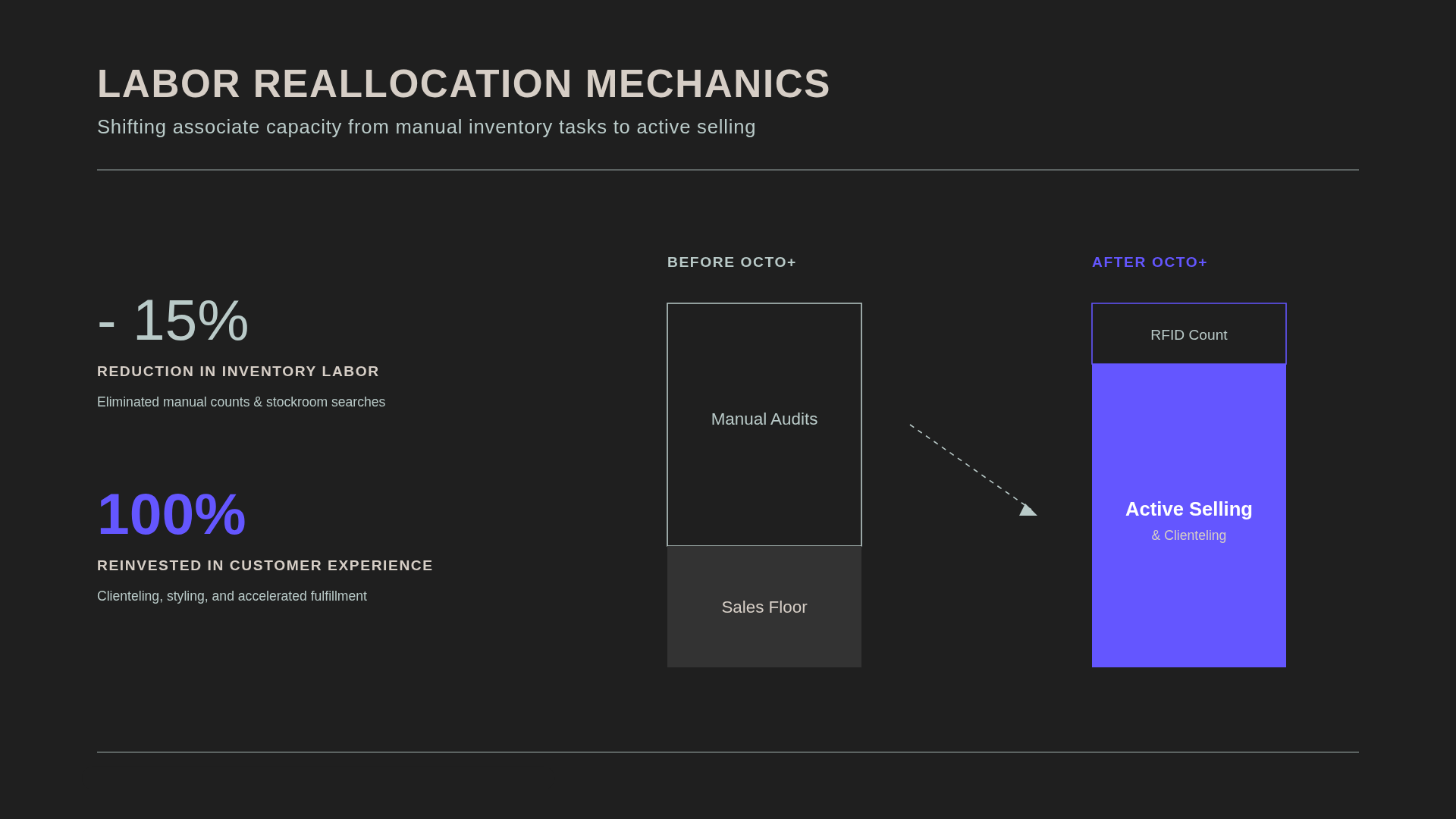
RP55 reduced full facility audit time from five business days to two, and brand cycle counts from three or four days down to one, after deploying Octo+.
Reduced shrinkage and theft
Item-level RFID for loss prevention raises revenue by up to 1.5% through reduced shrinkage and theft, according to Gartner*. The mechanism, item-level data identifying exactly when and where a product left the store, separates operational errors from actual theft and helps retailers make loss prevention decisions that are more precise and less reliant on guesswork.
Greater supply chain agility
When every item is live in the system from the point of source tagging, restocking decisions run on real depletion data rather than periodic snapshots. Inbound discrepancies surface at the dock rather than weeks later, enabling faster supplier accountability.
RP55 achieved 100% shipment accuracy for major EDI retail partners after deploying Octo+, with chargebacks issued automatically to suppliers for non-compliant deliveries.
Data-driven decisions and business insights
Every RFID read generates structured inventory data: what sold, what moved, what is sitting in the backroom, what has not been touched in weeks. That data feeds restocking, merchandising, and allocation decisions with a level of detail that manual counting cannot produce. According to ABI Research (2025)***, the retail RFID software market is shifting from middleware toward application-layer platforms focused on day-to-day workflows and analytics, reflecting a growing expectation that RFID technology should drive decisions, not just record movement.
RFID implementation: a step-by-step guide for retailers
Every successful RFID deployment starts from the retail problem, not the technology. The seven steps below reflect the sequence that produces measurable results and infrastructure that scales.
Step 1: define goals and assess retail needs
The question is not "how do we deploy RFID" but "what problem are we solving, and how will we measure whether it is solved." Set measurable baseline KPIs: current inventory accuracy, cycle count duration, on-shelf availability, BOPIS cancellation rate, before selecting any hardware or software.
Output: a defined target state the pilot can be measured against.
Step 2: evaluate infrastructure, tags, and tagging strategy
Audit existing store layout, POS, ERP, and network infrastructure before committing to a hardware configuration. Decide what to tag and where: source tagging at the manufacturer level is optimal, but distribution centre tagging is the practical alternative for retailers whose suppliers are not yet ready.
Output: a tagging plan matched to current supplier readiness.
Step 3: select technology, hardware, and software
RFID hardware, meaning tags, readers, antennas, and printers, is increasingly commoditised. The choice that matters most is the software platform: its ability to integrate with existing systems, manage data across multiple locations, support a gradual RFID adoption path, and convert raw reads into inventory data retailers can act on. Evaluate on integration capability and day-to-day workflow coverage.
Output: a shortlist evaluated on integration capability and scalability, not hardware specs alone.
Step 4: integration with existing systems (POS, ERP)
Integration is where most RFID projects succeed or fail. Legacy ERP and POS integration carries the most complexity and the highest risk of delays. Flexibility in integration approach matters: some platforms support native connectors for major ERPs; others provide robust ETL capabilities that allow integration with a wider range of systems. Prioritise a platform with a proven, adaptable integration approach matched to the systems already in use.
Output: RFID data flowing directly into existing retail systems.
Step 5: pilot and proof of concept
Run a controlled pilot in one store or one product category before scaling. Measure the pilot against the KPIs defined in Step 1, not general benchmarks. The pilot exists to produce evidence, not to validate a decision already made.
Output: an evidence-based decision to scale.
Step 6: train staff and support adoption
RFID only delivers ROI when store staff trust and act on the data it produces. Training on handheld readers and new workflows is the minimum. Clear accountability for accuracy targets, with support from managers, prevents post-rollout drift.
Output: a team that runs RFID as a daily operational habit.
Step 7: full deployment and ongoing monitoring
Scale on the evidence from the pilot. Monitor against the KPIs set upfront. Fixed and overhead readers at transition points, including dock doors, fitting rooms, exits, and across retail floor zones, give retailers an always-on data layer that makes ongoing monitoring sustainable without adding labour.
Output: an always-on setup that improves over time as RFID data accumulates.
Challenges and considerations for RFID adoption
Every RFID deployment comes with real considerations to plan around.
Investment and ROI
Costs break down into several categories: RFID tags, RFID readers (handheld and fixed), RFID printers, software platform licensing, integration services, and change management. For large retail networks, tag costs represent a significant and recurring expense given the volume of items tagged each year.
ROI follows correct implementation, and the payback timeline depends heavily on the scale of deployment, the use cases prioritised, and the quality of execution.
To reduce risk: set clear KPI targets before deployment and measure the pilot against them before committing to full rollout.
Technical integration complexity
Legacy ERP, POS, and WMS integration is the real complexity in any RFID deployment, not the hardware. Rigid integration requirements increase risk and extend time-to-value. A flexible integration approach matters here: platforms that offer both native connectors for major systems and ETL-based integration for others provide greater adaptability across the range of IT environments retailers actually operate in.
Data volume
High read volumes across a store network generate more data than a team can interpret manually. Raw read streams have limited value without a software layer to filter, interpret, and route them into actionable insights.
Change management and staff adoption
New workflows meet resistance, particularly from staff who have built effective workarounds around unreliable inventory data. Early training, clear ownership of accuracy targets, and hands-on support from day one prevent post-rollout drift.
Real-world examples: RFID success stories in retail
Varley: accurate inventory as a foundation
Varley, the UK and US activewear brand, was operating below 70% inventory accuracy before deploying Octo+. Discrepancies were creating friction across restocking, shipment verification, and KPI tracking. After deployment, accuracy reached 99%. Restocking became data-driven, shipment discrepancies surfaced immediately at the point of receiving, and store staff redirected their time from counting to helping customers.
RP55: supply chain accountability at scale
RP55, a Virginia-based wholesaler and 3PL provider for brands including Billionaire Boys Club and Hustle Gang, was running full facility audits that took five business days and relying on manual inbound verification. After deploying Octo+, inventory accuracy moved from below 65% to 97%. Full facility audits complete in two days. Brand cycle counts dropped from three or four days down to one. For major EDI retail partners including Dillard's, Saks, and Nordstrom, RP55 now achieves 100% shipment accuracy, with chargebacks issued automatically for non-compliant deliveries.
KIABI: RFID at enterprise scale
KIABI manages over 500 stores across multiple markets including France, Italy, Spain, Portugal, Belgium, and Switzerland, with €2.5 billion in annual turnover. At that scale, manual inventory processes were structurally incompatible with the pace of the business. KIABI deployed Octo+ across its store network, integrating RFID with self-checkout stations, zone-level cycle counting that runs without disrupting the sales floor, and RFID-based loss prevention. Inbound verification through RFID tunnels was deployed at the distribution centre level. The deployment supports KIABI's "Easy Shopping" positioning by keeping the customer experience fast, reliable, and consistent across the network.
The future of RFID technology in modern retail
The near-term direction for RFID in retail is clear across four converging developments.
- Predictive and automated restocking, where RFID data feeds models that recommend or trigger restock without manual intervention, reducing the gap between depletion and shelf replenishment
- Sensor fusion, where RFID alongside computer vision and ambient IoT creates richer store intelligence, including item location in real time and engagement mapping across the floor
- Always-on fixed and overhead reader infrastructure, where dock doors, fitting rooms, exits, and retail floor zones provide continuous item movement data without requiring handheld labour, progressively removing manual scanning from inventory tracking
- Digital Product Passport compliance, where EU regulation requiring item-level traceability from production to post-purchase is already being addressed by the RFID infrastructure many fashion, footwear, and luxury retailers have deployed
Frequently asked questions about RFID in retail
Is RFID reliable for retail operations? Yes, when correctly deployed. Tag selection, reader placement, and software integration determine how reliable the results are in practice. According to Gartner*, item-level RFID deployments can achieve inventory accuracy levels greater than 98%.
What are the primary benefits of RFID software for retailers? Inventory accuracy from 60-65% to above 98%, significantly faster cycle counts, real-time restocking alerts, item-level data for loss prevention and omnichannel execution, and 1-3.5% sell-through improvement from better on-shelf availability.
Does RFID replace barcodes completely? In most retail environments, RFID and barcodes coexist. Barcodes remain useful at single fixed scan points and for low-volume items where the per-tag cost of RFID is not justified. RFID earns its value where bulk reads and item-level accuracy matter, and many retailers run both technologies in parallel depending on the product category.
What support do retailers need during an RFID rollout? Training on handheld readers, clear ownership of accuracy targets, and vendor support covering both hardware and software integration. Treating support as a one-time training event rather than an ongoing service tends to lead to accuracy drift within the first year.
How long does a typical RFID implementation take? A pilot covering one store or one product category typically runs 8-12 weeks. Full enterprise rollout timelines depend on the number of stores, the tagging strategy, and integration complexity.
Can RFID improve the customer shopping experience? Yes, directly. Faster checkout, more reliable BOPIS fulfillment, smart fitting room capabilities, and real-time item location for store associates all reduce the friction between a customer question and a completed sale.
Does RFID work for a small retailer? Yes, though the business case looks different. A smaller retailer with one or two stores may find a phased pilot in a single high-value category, such as apparel or footwear, delivers most of the accuracy gain without the cost of tagging an entire catalogue at once.
The deployment approach
The question for most retailers today is no longer whether RFID technology delivers value, but how to deploy it in a way that produces consistent, measurable results across their specific stores, suppliers, and customers. The retailers who get the most from RFID start with clear operational goals, choose a software platform built for their integration environment, and scale on the evidence their pilot produces.
Speak to the Frequentiel team about your RFID project
Sources
* Gartner, "How Retailers Can Leverage Item-Level RFID to Boost Revenue and Reduce Cost", G00788040, 2023. gartner.com/en/documents/4227199
** Fulfil.io, BOPIS cancellation rates, Fulfil.io blog. fulfil.io/blog/omnichannel-fulfillment
*** ABI Research, "From Hardware to Software: How RFID Is Transforming Retail", Tancred Taylor, October 2025. abiresearch.com/blog/rfid-in-retail
